Bullet "Spin" and Why
By Gregory Kielma
What Happens If There Is Too Much “Spin” or Not Enough on a Bullet Fired From a Firearm?
What Happens If There Is Too Much “Spin” or Not Enough on a Bullet Fired From a Firearm?
Gregg Kielma
If the rotation rate is too fast it is possible for the bullet to fly apart. To give you an idea of how fast bullets are spinning, let’s use a .223 bullet fired with a muzzle velocity of 2900 feet per second out of a barrel with a 1:7 twist rate (1 rotation in 7 inches):
2900 fps = 34,800 inches/sec
1/7 rotation/inch * 34,800 inch/sec = 4,971 revolutions per second
4,971 rev/sec * 60 = ~300,000 rpm
So, your typical AR-15 round spins 300,000 times per minute. Just a comparison my 370 Z in race mode…8000 RPM. What a difference.
If you put too much spin on a bullet they can literally fly apart, especially for larger diameter bullets. This is why .30 Caliber rounds are typically fired out of barrel with a much slower twist rate of 1:10 or 1:12.
The other issue is that the higher twist rate imparts more friction/resistance on the bullet which increases pressure in the barrel, so it is possible to blow up a barrel if you overload the charge on a high twist barrel.
You typically use fast twist barrels of 1:8 or 1:7 for long skinny bullets like 77 gr 223. Those need a faster spin to keep them stable in flight and prevent “keyholing” which is when the bullet tumbles in flight. Tumbling in flight is what happens when you don’t have enough spin and obviously results in poor performance.
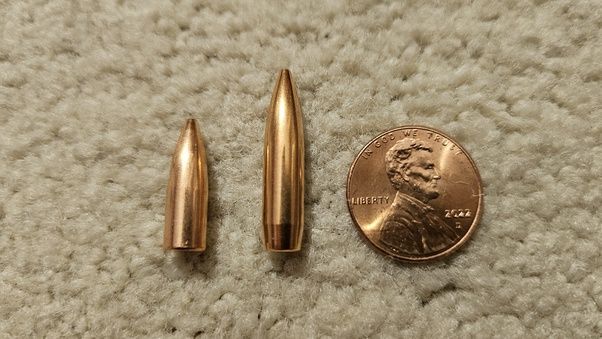
You often can’t tell because the bullets are seated in the cartridge case and you can’t see it, but there are significant differences in bullet (projectile) length. 55gr .223 on the left, 77 gr on the right.