Florida and The Burmese Python I LOVE FLORIDA!
By Gregory Kielma
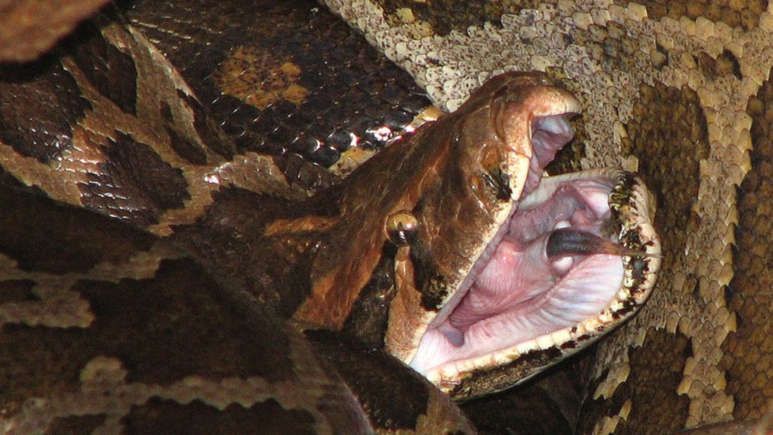
The Tail and Truth of the Dreaded Burmese Python
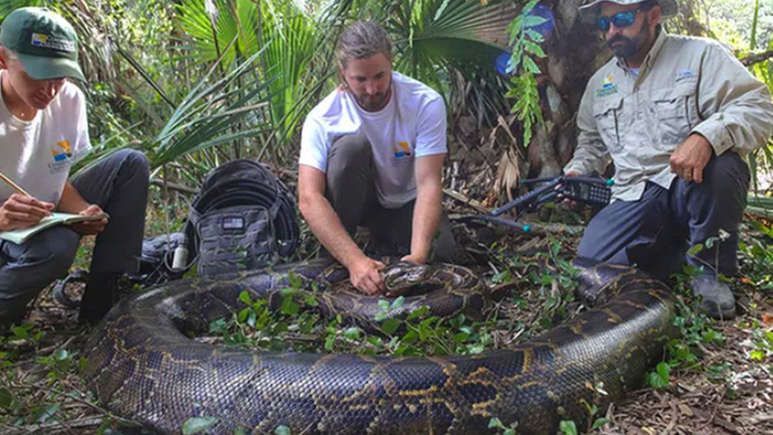
Man Wins Thousands After Ridding Everglades of Very Invasive Snake Species
The Tail and Truth of the Dreaded Burmese Python
©Source: Conservancy of Southwest Florida Discussing the environment is an easy way to discover which way someone leans politically, as well as their feelings about the planet.
Invasive species are animals and plants that are introduced to an environment they are not native to, which then become overpopulated and harm their environment. Invasive species adversely affect habitats and bioregions, causing ecological, environmental, and economic damage.
Invasion of species into long-established ecosystems is a natural phenomenon, but human-facilitated introductions have greatly increased the rate, scale, and geographic range of invasion over time. This began with their earliest migrations, accelerating in the Age of Discovery, and then accelerating again with international trade.
Not all invasive species are immediately obvious to the layperson. An obvious example of an invasive species would be the European rabbit in Australia, where rabbits proliferated rapidly after their introduction in the 18th century, and currently cause millions of dollars’ worth of damage to crops.
On the other hand, house cats are also considered an invasive species, which many people now believe to be a standard part of everyday life. Invasive species are not always harmful in the way that many people consider harm, but they are almost always displacing and disrupting the environment that they’re introduced to, meaning that they need to be dealt with.
In Florida, invasive species are particularly important to deal with considering the delicacy of the wetland ecosystem. Wetlands are an important environment that need to be protected as the planet slowly grows hotter, and preserving natural ecosystems and animal systems are an important part of that.
The Burmese python is an invasive species in the area, which unfortunately is an apex predator. This means that, once the animal reaches adulthood, there are very few other predators that can attack it to manage its natural population, meaning that the burden of population control falls on humans.
The Burmese python is a species of snake that is native to Southeast Asia. It was introduced into Florida going back as far as the 1930’s, and was first sighted in the Everglades National park in the 1990’s. It wasn’t until 2000 that they were recognized as a reproducing population there, and since then, the population of pythons in the Everglades has exploded.
These pythons are a particularly insidious breed of invasive snake in Florida. They can grow up to twenty feet long and weigh up to 200 pounds, meaning that there are very few natural predators for the reptile. They prey on a wide variety of birds, mammals, and crocodilian species in the area, and since their proliferation, there have been pronounced declines in several mammalian species in the area.
Because the Burmese python has few natural predators in the area, the Florida government has had to come up with different methods to try and control the population of snakes in the area, with limited success.
Part of the problem around trying to control the populations of this animal is the fact that many of the habitats that the Burmese python inhabits are inaccessible to humans. This means that animal control groups have had to get creative with their efforts.
One of these efforts is called the Florida Python Challenge, a statewide hunting competition. This is a challenge that pulls in hundreds of participants every year, competing for the grand prize of $10,000.
Most recently, this top prize was brought home by Tennessee resident, Paul Hobbs. He traveled to Florida with his father, son, and brother-in-law to participate in the challenge, and ultimately captured 20 Burmese pythons during the 10-day hunt.
The Hobbs family tradition of participating in the python hunt started with Hobbs and his father, Tom, who has won the novice category in the event. “As soon as you see one, the adrenaline just kicks in,” Hobbs said in an interview. “You’re all flying out of the vehicle and ready for the ride.”
More than 200 snakes were captured and killed during the hunt, which is a significant win for environmental control efforts. Each female snake can lay up to 100 eggs over the course of its lifetime, which explains how and why the population of snakes exploded in Florida in such a short period of time.
Since 2000, almost 20,000 pythons have been caught and killed in the Sunshine state. This is a mere drop in the bucket of the natural population, though, which is estimated to be as many as 300,000 individuals living in the Everglades alone, according to the state Fish and Wildlife Conservation Commission.
Ron Bergeron, a governing board member of the South Florida Water Management District, said, “It becomes the top of the food chain. We have found a full, whole deer inside of a python - up to a seven-foot alligator.”
The Florida Python Hunt is not the only time that these animals are hunted for the state, though. Contractors who are paid to hunt the pythons year-round have removed 11,000 of the animals since 2017, according to the Miami Herald.
A U.S. Geological Survey report called eradication of the animals “likely impossible,” though. “They’re an apex predator. Essentially when they become adults, there’s really nothing that preys on them,” said FWC nonnative fish and wildlife coordinator, McKayla Spencer.
She continued, “We don’t currently have a way to eradicate them, but in the last few years, we’ve made some great strides. Every python removed is one less python to harm our native species.”
In order to compete in the Florida Python Hunt, participants must complete a training course. These are dangerous predators, and people cannot sign up to engage with them willy-nilly. Individuals are disqualified if they kill a native snake, or if they inhumanely kill a python. The goal is population control in this contest, not animal cruelty or further environmental harm.
The Everglades is a 2 million-acre subtropical wetland, which once featured uninterrupted flowing water over an area that was nearly four times as large as it is today. It’s an important environment for many species, and preserving it is a top priority for many environmental agencies in the South, and specifically in Florida.
Controlling the local population of Burmese Pythons is merely one way that environmental agencies are seeking to restore the natural beauty of the Everglades. Other efforts include the $1 billion Kissimmee River restoration project. These efforts prove how important the Everglades is to environmentalists, and it’s clear that the goal is help restore the American wetlands to some semblance of their former glory.