Gun Laws, Are They Flawed?
By Gregory Kielma
How flawed are America's gun laws?
How Flawed are America's Gun laws?
Gregg Kielma Firearms Instructor- FFL- Gunsmith
Bill Caffery
Seriously flawed.
Most American gun laws are geared towards the point-of-sale through legal, licensed gun dealers, also called Federal Firearms Licensees (FFLs). That is, when you purchase a firearm from a licensed dealer, you must fill out and sign a form, provide ID, and wait while they run a “background check” on you. That can take seconds, or it might take up to 3 days. Some states include “waiting periods” of up to 10 days before you can take possession of the firearm you’re holding in your hands.
All the paperwork done by the FFL dealer has to be kept by the dealer. Any small error on the forms can cause the dealer headaches with the authorities. A transposed serial number or the wrong model number can result in federal prosecution.
Some cities, and even a few states, require you to obtain a permit each time you want to purchase a firearm. In some cases, processing that permit may take months, even more than a year. Once you get that nice permit in hand, you can buy the gun. But then you need to have a different permit to keep it in your home in the city and the long process starts all over again. This is a serious infringement on the right to own a firearm.
While some of this may sound “natural” to people in other countries, the problem with this is that less than 1%-2% of gun purchases at gun dealers are made by people with criminal records. Criminals don’t obtain their firearms from gun dealers, gun shows, or pawn shops.
Illegal Sales
Most criminal acquisitions of firearms are black market sales or trades. Danny Dirtbag wants a gun so he might offer Rotten Richie a quantity of drugs for one he has. Or Rotten Richie “knows a guy” who will sell him a gun, which he will then give/sell to Danny.
Where do those guns come from? Most are taken in burglaries. Burglaries of homes, of sporting goods stores, gun shops, etc. Those are sold to a “fence” who gives the thief some money for the gun and the thief often buys drugs with the money. Other times, gang members get jobs with shipping companies that ship guns from distributors to retailers and they make a box “disappear” in-transit. Those guns end up on the black market.
Many years ago, someone documented how long it took for a criminal to obtain a firearm. A criminal could obtain an illegal firearm in as little as 30 minutes with cash. No questions asked. Out of 5 attempts, the longest it took was 29 hours. This was at a time when there was a 5-day “waiting period” on most handgun sales. So, the desperate citizen who wanted a gun had to wait 5 days, while the criminal he feared could obtain one before the sun rose the next day.
So, the existing gun laws have created an underground world of gun sales that offer easy availability and are “off the record.” A gun from these illegal sales is essentially untraceable to the person who possesses it or left it at a crime scene. Police can trace the legal sales from manufacturer to distributor to the retailer to the first purchaser of the firearm. If that firearm was reported lost or stolen police only know who the last legal owner was, not who used it in a crime.
Prohibited Persons
The laws list several disqualifying characteristics for purchasing or possessing a firearm. These include people convicted of felonies or certain misdemeanor crimes, fugitives from justice, people in the country illegally, those dishonorably discharged from the military, users of controlled substances (drugs), those with restraining orders against them and people a court has found to be mentally unfit or insane.
Yet, a study in the City of Pittsburgh showed that 80% of people illegally carrying guns were prohibited from possessing guns.
The laws don’t seem to be working very well.
Bargaining Chips
Part of the problem is when Danny Dirtbag, with a criminal record of theft, robbery and burglary, is caught with a gun, he may not go to jail for it. If he’s charged with other crimes — like robbery using the gun — his lawyer will offer a guilty plea to some lower offense like “aggravated assault” if the prosecutor will dismiss the felon in possession charge. There’s method in the madness here. A state charge for possession may not be quite as harsh as the Federal charge (up to 10 years in prison), but it will certainly add several years to the robbery charge. By pleading to a lesser charge, it disposes of the case faster and Mr. Dirtbag is locked up for a year or two, instead of maybe 8–10 years.
The result is many criminals don’t fear many of the gun laws because lawyers will play Let’s Make A Deal with prosecutors.
A few “pilot” programs have been run in different parts of the country where felons are prosecuted in a federal court for possession and plea bargains aren’t on the table. The results were encouraging. Violent crime was significantly reduced in those communities during the program. However, problems arose when lawyers alleged the programs were “racist” and impacted poor minority communities, where most of the violent crimes occurred, the most.
On The Other Hand
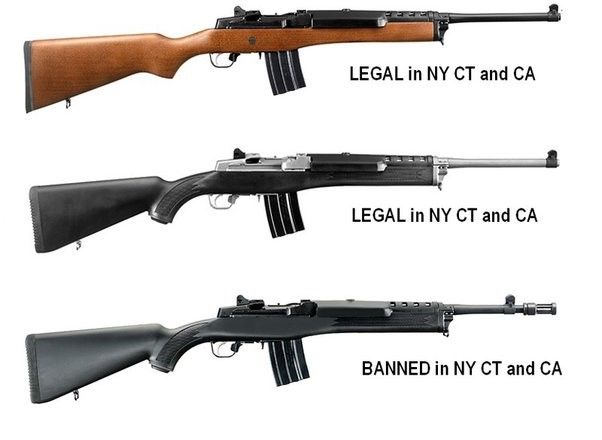
In some states certain rifles are restricted based on certain features of the rifle, not how powerful or deadly they are. One version of a rifle can be legal while a different version of the same rifle is a felony to own. The graphic below illustrates how easily one can violate the law.
If an unaware gun owner purchases either of the legal rifles shown above in certain states and adds a device to the end of the barrel (e.g. a “flash hider” or muzzle brake) it becomes an illegal rifle. Such a device doesn’t change a thing about how the rifle functions or operates, doesn’t make it “more powerful” or more accurate. But it does make it a felony to have.
But what happens when someone is caught with one of these rifles? Let’s look at the difference between Danny Dirtbag and John Q. Citizen.
Danny Dirtbag gets a hold of the illegal rifle via illegal sales and uses it to hurt someone in a robbery or other crime. His lawyer plays Let’s Make A Deal so that Danny pleads guilty to “robbery” or even “armed robbery” if the prosecutor drops the “assault weapon” charge, the felon in possession charge and the possession of a stolen firearm charge. It’s easy for the prosecutor to dismiss those charges to get a fast conviction and Mr. Dirtbag is off to the State-run Graybar hotel for a 3-year stay.
But John Q. Citizen has a different problem. Two men kicked in his front door and threatened his family, but he used his legally purchased, but modified rifle, to wound both criminals who terrorized his wife and daughters. Police investigate and determine the shooting was justifiable self-defense of his family. But they confiscate his “illegal” gun. The prosecutor decides to prosecute, and Mr. Citizen is looking at up to 10 years in prison, all because of a cosmetic feature of his rifle. His choice is to spend tens of thousands of dollars on a lawyer to stay out of jail or try to work on a deal that doesn’t involve jail time or bankruptcy-inducing fines. He may also lose his house, his wife, and his job or his entire career in the process. He will certainly lose his $800 rifle regardless. The bad news is the prosecutor doesn’t have to deal with it here. He can “make an example” out of Mr. Citizen and press for a trial and the maximum sentence.
What’s Missing?
Since certain people are the ones who the law says should not have firearms, one simple method could cut down on a lot of the nonsense everyone has to put up with when purchasing a gun. That is to provide an ID to the prohibited persons that has a distinguishing color — say red. A red ID card will stop them from buying a gun anywhere from any legal seller. And if caught with a gun and a red ID card, it’s an easy arrest for the police. For the prosecutor, it’s an easy conviction because we make that crime non-negotiable.
Some will claim the red ID card will “stigmatize” the person and make it harder to get a job or do other business. Well, it should. There should be serious consequences for serious crimes.
But we can also offer a “way out” of that problem. If the person rehabilitates their life and stays out of trouble for a period (5 years? 8 or 10 years?) they get their rights back and get a standard ID card (notwithstanding certain exceptions).
There are many more flaws I could write about, but I’ve written enough, and dinner is now ready.