In Our Series What Would You Do? Home Confrontations
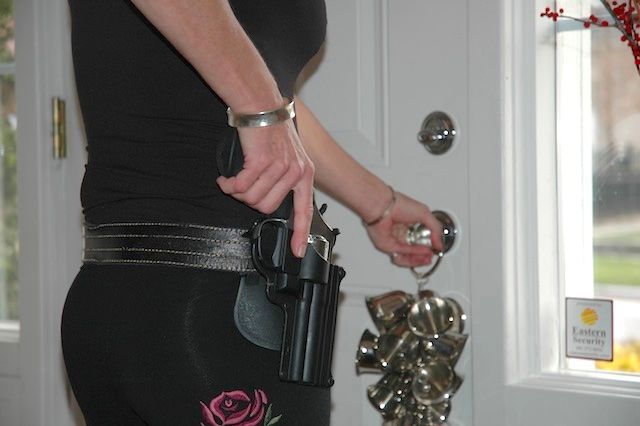
Would you shoot an unarmed home invader that was robbing your house when you surprise him by arriving home?

Would you shoot an unarmed home invader that was robbing your house when you surprise him by arriving home?
What Would You DO?
First of all, he’s a burglar, not a home invader. Home invasion implies someone at home when the intruder gets inside. But that’s a minor point.
Let’s assume he’s entered from the back yard and nothing seems amiss when I pull into the driveway.
If he bolts out the front door and runs away, there is no threat to my life, so no reason to shoot him.
However, if I enter the house to find him inside, things will get interesting. Once again, if what I’m seeing is his backside exiting the house, he’s no threat to me.
Just because he is “unarmed” does not mean he doesn’t pose a threat to my life or the lives of others in the home. Prison inmates have killed other inmates with one of those stubby golf pencils so the term “unarmed” is somewhat relative.
Burglar Quick Facts
A study by the University of North Carolina (UNC) of convicted burglars revealed:
• 51% of burglars are in need of money for drugs
• 41% suggested it was most often a “spur of the moment” event/offense
• 73% of the sample indicated that they had used drugs and/or alcohol while engaged in a burglary
• Crack or powder cocaine and heroin were the drugs most often reportedly used.
• 79% reported an interest in acquiring cash during their burglaries, followed by jewelry (68%), illegal drugs (58%), electronics (56%) and prescription drugs (44%).
From the above, the burglar you encounter likely has a drug problem and 3/4 of them may have consumed cocaine or heroin before committing the crime. This does not bode well for the average person defending their home.
Confrontation
On the other hand, if I enter the house and he’s visible to me, he’s going to be looking at a the business end of a big bore handgun and hearing me telling him to show me his hands and/or get on the ground. Movement towards me will be considered a grave threat (it indicates he thinks he can disarm/overwhelm me) and loud noises will ensue. If he cooperates he’s going to jail instead of the hospital or morgue.
If I enter the house and he’s in the kitchen, any furtive movements on his part will be interpreted as hostile and threatening. That’s because I know many burglars will arm themselves with a kitchen knife during the crime and then leave it behind before exiting. That way they’re armed inside, but if police catch them outside it doesn’t appear they were armed during the crime.
If I arrive home and hear him in a bedroom or another room of the house, I may retreat back out of the house and call 911. This is because I’ve only heard, not seen him and he may not be alone. It’s safer if the burglar is outnumbered when the confrontation occurs.
Special Circumstances
All of the above makes a big assumption — that none of my family is in the house.
If I return to the house, having left a family member or two there, my concern is for their safety. If they are not present or visible when confronted with an intruder, he does not leave regardless of being passive or not. Not until I can ascertain the safety and well-being of family members or guests.
I didn’t normally worry about it too much in earlier times, however. Most of the women I’ve known were quite capable of defending themselves. If someone were breaking into the house I’d expect her to react appropriately.
The intruder had best pray that he didn’t break in during her “special week” or try to steal her ice cream.
Some years ago, the house was never empty. Even if no one was home, it was still occupied by a “family member.” And I would take as much offense at someone hurting my dogs as I would a human family member.
If I were to enter the house and not be greeted by my dog and confront an intruder, there are very high odds he would not leave the house vertically. Anyone who was capable of incapacitating or killing a dog the size of a Doberman is a lethal threat.