Locking Holsters: Are They Right FOR YOU? LET'S TAKE A LOOK
By Gregory Kielma
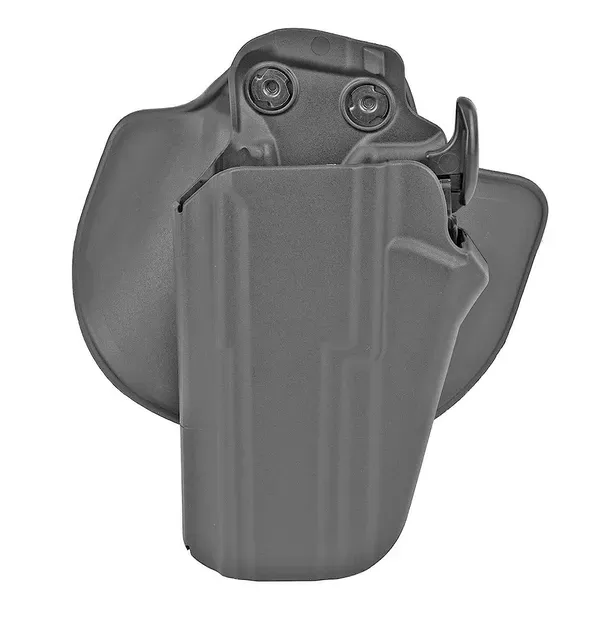
Why do policemen carry their sidearms in open holsters? Is it easy for anyone to grab them?
Why do policemen carry their sidearms in open holsters? Is it easy for anyone to grab them?
Gregg Kielma
Unknown to most people with casual familiarity with firearms, virtually all holster (especially those used by law enforcement) have a locking system, even if it isn’t easily seen.
In fact, I don’t know of any police departments that doesn’t require one on holsters. Now some are much more effective than others, but almost all of them require one. For civilians, especially if carrying concealed, this system just uses tension, but even most civilians use holsters with a locking system that needs to be disengaged before drawing a firearm. The best locking systems can, with practice, be disengaged while drawing, in one smooth action.
The holster above is from Safariland and uses their GLS locking system. On the right-hand side is a small protrusion which is a lock release. If you are drawing correctly, as you grab the firearm your finger should automatically hit and release it. While it takes some practice to make it completely smooth, most concealed carriers and law enforcement should already be practicing their draws at least once a week. On the other hand, if you are unfamiliar with the system (which 99% of the general public is) you’ll have no clue how to disengage the lock and will only end up pulling the wearer’s pants up an inch or two. Even if you pulled hard enough to remove the holster completely from the wearer’s pants, you still wouldn’t be able to use the firearm as all proper holsters (which is all the holsters Safariland makes) completely cover the trigger (never buy a holster that doesn’t completely cover the trigger). Many manufacturers produce similar holsters that use their own unique proprietary systems, the one below just happens to be the one I’m most familiar with.